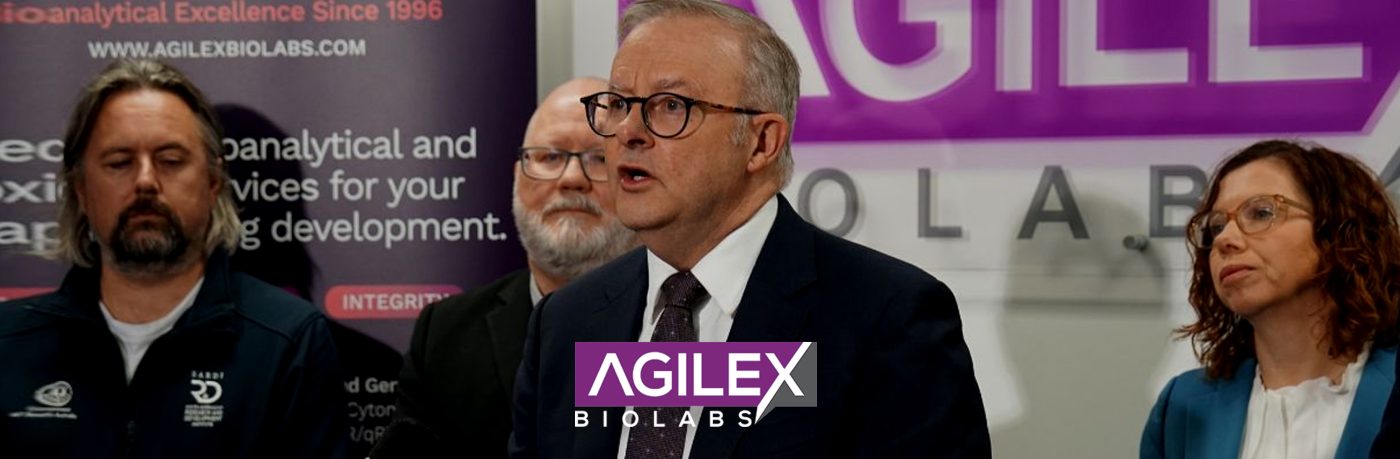
Agilex Biolabs laboratory in Thebarton, South Australia, is the first facility in Australia to be accredited for the analysis of Brevetoxins in shellfish, marking a significant step forward in the fight against the recent algal bloom problem affecting shellfish in that State. The laboratory’s expanded capability forms part of the $28 million algal bloom support package jointly funded by the Albanese Government with the South Australia Government.
Brevetoxins are toxins produced by certain species within the Karenia genus. An unusual aspect of the South Australian algal bloom is that brevetoxins have been detected in association with Karenia cristata, a rare species of algae not commonly linked to brevetoxin production. Historically, Neurotoxic Shellfish Poisoning (NSP) events have most often been associated with Karenia brevis, making the South Australian bloom scientifically noteworthy.
When accumulated in shellfish consumed by people, the toxin can cause NSP. To ensure that shellfish such as pipis, oysters, and mussels are safe for consumption, each fishery needs to confirm that samples are below the limit for brevetoxins using an accredited method.
At the beginning of the algal bloom, testing of brevetoxin levels was done by the South Australian Quality Assurance Program (SASQAP). However, at the time, the only accredited testing option available to SASQAP was in New Zealand. This meant local producers experienced delays in sample results of up to a week, since they were unable to commercially harvest until they received clean results.
Agilex already operated as a world-class bioanalytical facility specialising in Liquid Chromatography-Tandem Mass Spectrometry (LC-MS/MS) analysis in support of clinical trials, providing both the advanced instrumentation and method development capability required for toxin quantification. This placed it in a unique position to efficiently adapt its LC-MS/MS platforms to develop, validate, and implement a quantitative method specifically for brevetoxins in shellfish.
The organisation has a history of accreditation with NATA, having maintained NATA accreditation to ISO/IEC 17025 since 2004. This meant it already had the quality systems, trained staff, inbuilt data integrity and quality control processes, and a level of audit preparedness to fast-track NATA accreditation to extend the scope to include testing for brevetoxins.
Agilex worked closely with the IANZ-accredited New Zealand testing laboratory and NATA to ensure that it could implement an equivalent, accredited method to enable the testing and release of South Australian shellfish. Both laboratories were keen to collaborate to help combat the algal bloom problem in South Australia and took every measure to ensure a successful transfer of the method.
With its testing of Brevetoxins accredited, Agilex expects this new capability to provide a level of assurance for regulators, seafood producers, and consumers that shellfish are thoroughly screened and safe for consumption. Whilst the majority of South Australia’s shellfish industry has been open and trading as usual, shellfish producers now have access to testing results within days of harvesting, allowing them to resume operations sooner when toxin levels are safe, which helps to minimises economic loss and provide much greater certainty to the fishing community.
Accreditation also supports sovereign analytical testing capabilities, reducing reliance on overseas labs to safeguard public health.
South Australia’s algal bloom was first detected in South Australia’s Fleurieu Peninsula in early 2025 before spreading to Gulf St Vincent, Spencer Gulf, and the Fleurieu coastline. It is attributed to a combination of nutrient-rich floodwaters, ocean upwelling, and a prolonged marine heatwave.