

Measurement uncertainty (or ‘MU’) is often seen as a barrier to accredited facilities – a niche technical concept that only matters to research scientists. It’s something to calculate for compliance purposes and move on from. In practice, it is one of the most useful tools available for decision makers. Having an intuition for MU enables you to make decisions that are data driven, technically valid, and ultimately less risky.
Every day, accredited facilities and their stakeholders make decisions that depend on NATA-endorsed test results. A regulator may have to decide whether a given food product is safe to eat; a pathologist may recommend a particular treatment; a construction project may only proceed when the concrete is sufficiently cured.
All of these decisions are made with a combination of data (measurements) and professional judgement. In many cases, the ultimate decision rests on statements in NATA-endorsed reports, such as ‘pass’ or ‘fail’, ‘compliant’ or ‘non-compliant’, ‘safe’ or ‘unsafe’.
However, human decision-making is not purely data driven. It is shaped by intuition, experience, and bias. While this may be effective in everyday situations, it creates risk when applied to technical outcomes that require consistency, accuracy, and defensibility. This is where MU becomes a valuable tool.
What Measurement Uncertainty Really Means
All measurements contain some level of uncertainty. No instrument or method can determine a value with complete precision. In other words, there is always doubt about the ‘true’ value of a measurement.
A practical way to think about this is to imagine a ‘cloud’ of doubt around every test result. The reported value sits within a range of possible true values, and the size of that range reflects the level of uncertainty.
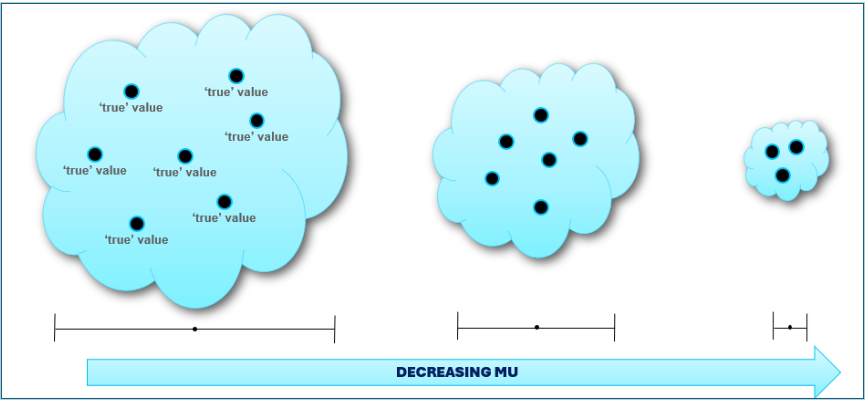
– A small cloud indicates higher confidence in the result (less MU)
– A larger cloud indicates lower confidence (more MU)
This concept is already familiar. In everyday language, terms like “about,” “roughly,” and “give or take” reflect the same idea. Measurement uncertainty formalises this intuition so it can be applied consistently and objectively.
The thing that sets MU apart from a vague sense of doubt is that it can be quantified. In other words, you can characterise the size of the cloud.
Why it Matters for Compliance Decisions
Many accredited activities involve comparing results to specified limits. When a result is clearly above or below a limit, the decision is straightforward.
The challenge arises when results are close to that limit.
Without considering uncertainty, a result may appear compliant. However, when the “cloud of doubt” is taken into account, the true value may fall on either side of the threshold.
This is where measurement uncertainty becomes critical. It allows facilities to:
– understand how close a result is to a limit
– assess the confidence of a compliance decision
– identify where decisions carry higher risk
Rather than relying on a simple pass/fail outcome, uncertainty introduces a more realistic view of the result and its implications.
Where Uncertainty Comes From
The level of MU is influenced by multiple factors or components. (Consider a group of small clouds of doubt, merging into a single large cloud of MU.) These components can include:
– the performance and calibration of equipment
– environmental conditions
– operator technique
– characteristics of the item being measured
Each factor contributes differently to the overall uncertainty or doubt. Identifying and understanding these contributors helps build a clearer picture of how reliable a result is and where improvements can be made.
Turning Uncertainty into Something Usable
To apply MU effectively in day-to-day work, it helps to focus on three practical questions:
1. What is being measured?
In the context of accreditation, a test ‘result’ can mean many things. It can be a single value (i.e. a single measurement), a range of values, a statement of conformity (e.g. pass/fail), or even a set of probabilities.
2. How uncertain is it?
How large is the cloud of doubt? What are the smaller contributions to the overall size of the cloud?
Estimate the range of possible values around that result. This can be expressed in units, percentages, or statistical terms.
3. What does that mean for the decision?
Consider how that range interacts with any relevant limits or specifications.
When MU is understood (i.e. quantified), the level of risk associated with a decision can also be understood.
Strengthening confidence and defensibility
Being able to demonstrate the confidence in a test result (i.e. the MU), strengthens its credibility.
Applying MU supports this by:
– providing transparency around the reliability of results
– supporting consistent decision-making across similar cases
– enabling results to be defended when challenged
A Practical Shift in Mindset
One of the most common barriers to using MU effectively is the perception that it is overly complex or not relevant to day-to-day work.
In reality, it is a practical tool for which you already have a great deal of intuition!
All measurements involve some level of doubt. That doubt can be estimated and used to inform decisions. When applied correctly, measurement uncertainty helps ensure decisions are not only compliant, but also well-informed and aligned with risk.
For further information, please refer to the authority on MU: the ‘GUM’ or Guide to the Expression of Uncertainty in Measurement. This is published by the BIPM, the international authority on measurement uncertainty: